

NAME
mdee - em·dee, Markdown Easy on the Eyes
SYNOPSIS
mdee [ options ] file ...

 -h  --help             show help
     --version          show version
 -d  --debug            debug level (repeatable)
 -x  --[no-]trace       trace mode (set -x)
 -n  --dryrun           dry-run mode
 -s  --style=#          output style (nup/pager/cat/filter/raw)
 -f  --filter           shortcut for --style=filter
 -p  --plain            shortcut for --style=pager
     --[no-]fold        line folding (default: on)
     --[no-]table       table formatting (default: on)
     --[no-]nup         nup paged output (default: on)
     --[no-]rule        use Unicode rules for tables (default: on)
 -w  --width=#          fold width (default: 80)
 -t  --theme=#[,#,...]  color theme(s) (default: hashed)
 -m  --mode=#           light or dark (default: light)
 -B  --base-color=#     override base color of theme
                        (e.g., Ivory, #780043, (120,0,67))
     --list-themes      list available themes
     --show=#           set field visibility (e.g., italic=1)
 -C  --pane=#           number of columns
 -R  --row=#            number of rows
 -G  --grid=#           grid layout (e.g., 2x3)
 -P  --page=#           page height in lines
 -S  --pane-width=#     pane width (default: 85)
--bs --border-style=#   border style
     --[no-]pager[=#]   pager command
VERSION
Version 0.15
DESCRIPTION
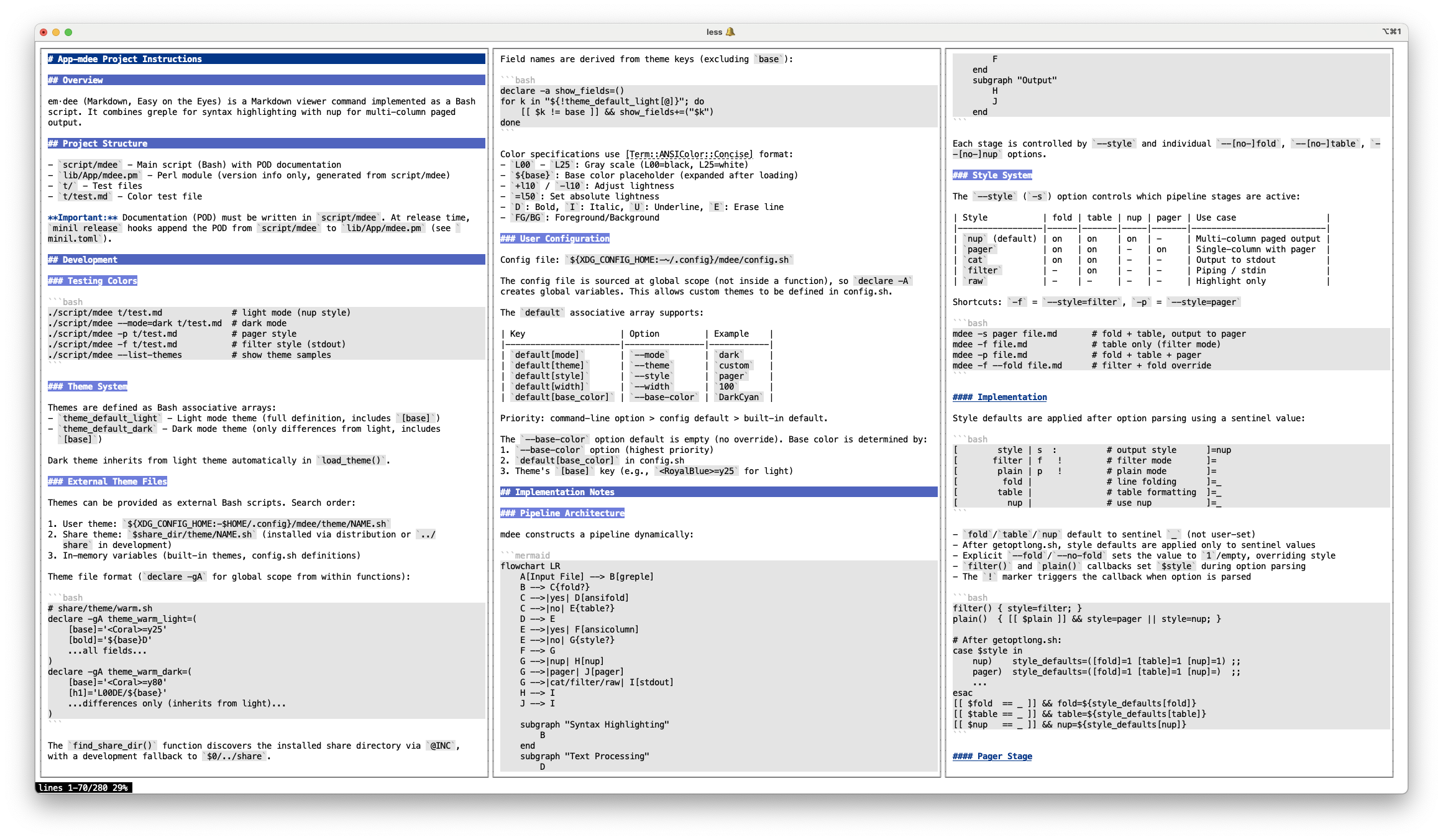
em·dee (command: mdee) is a terminal-based multi-column
Markdown text viewer with syntax highlighting, particularly
useful for reading documents generated by LLMs.
It displays Markdown text as-is with minimal formatting: syntax
highlighting, line folding for long list items, and table column
alignment. Markup characters (**, `, #, etc.) are
preserved in the output. By default, closing hashes are appended
to h3-h6 headers (via the built-in hashed theme) to make
heading levels visually distinct. Link URLs are removed from the
display, showing only the link text (e.g., [text](url) becomes
[text]). On terminals supporting OSC 8 hyperlinks, the link
text remains clickable.
It does not render Markdown into formatted output or reflow
paragraphs. For full Markdown rendering, many other viewers are
available. Combine them with nup(1) for similar paged output
(e.g., nup glow README.md).
The pipeline combines greple(1) for colorization and nup(1) for multi-column paged output.
Supported elements: headers (h1-h6), bold, italic, strikethrough, inline code, code blocks, HTML comments, tables, and list items.
Multi-column Layout and Pagination
By default, mdee calculates the number of display columns by dividing the terminal width by the pane width (default 85 characters). This determines how the output is laid out and paginated.
When two or more columns fit, nup(1) arranges output in multi-column layout with page-by-page pagination — content is split into terminal-height pages viewed through a pager.
When only one column fits, mdee still uses nup for formatting (borders, document layout) but disables page-by-page splitting, so the content scrolls continuously in the pager. This avoids wasted space from page breaks on narrow terminals while maintaining the same visual appearance.
To force page-by-page pagination even in single-column layout,
specify --nup explicitly. The --pane-width (-S) option
adjusts the column width used for this calculation, and
--pane (-C) sets the number of columns directly.
Use -p (--style=pager) for a simpler view without nup
formatting — highlighted output is piped directly through a
pager. Use -f (--style=filter) to write highlighted
output to stdout without a pager, suitable for piping into
other commands.
INSTALLATION
Homebrew
Use tecolicom/tap:
brew tap tecolicom/tap
brew install app-mdee
CPAN
cpanm -n App::mdee
OPTIONS
General Options
-
-h, --help
Show help message.
-
--version
Show version.
-
-d, --debug
Set debug level. Can be repeated for increasing verbosity.
-
-dShow theme values (
theme_light[]/theme_dark[]) and pipeline stage names. Output is in sourceable format that can be used in theme files or config.sh. -
-ddAbove, plus expanded color values (
colors[]), pattern definitions (pattern[]), and full command lines for each pipeline stage.
-
-
-x, --trace, --no-trace
Enable or disable shell trace mode (
set -x). Useful for debugging script execution. Can be toggled:-x --no-xenables then disables tracing. -
-n, --dryrun
Dry-run mode. Show the pipeline without executing. With
-dd, shows expanded command lines for each stage instead of function names.
Processing Options
-
-s STYLE, --style=STYLE
Set the output style. Default is
nup. Available styles:nup- Full pipeline: fold + table + nup paged output (default)pager- Fold + table, output to pager ($PAGERorless)cat- Fold + table, output to stdoutfilter- Table only (no fold, no nup), suitable for pipingraw- Highlight only (no fold, no table, no nup)
The style sets the initial state of
--fold,--table, and--nupoptions. Subsequent options can override individual settings:mdee -s filter --fold file.md # filter + fold mdee -p --no-fold file.md # pager without fold -
-f, --filter
Shortcut for
--style=filter. Reads from stdin (or files) and outputs highlighted Markdown to stdout. Disables line folding and nup paged output, but keeps table formatting enabled. Useful for piping Markdown content through mdee for syntax highlighting. -
-p, --plain
Shortcut for
--style=pager. Enables fold and table formatting, outputs through a pager ($PAGERorless) instead of nup. -
--[no-]fold
Enable or disable line folding for list items. When enabled, long lines in list items are wrapped with proper indentation using ansifold(1). Default is enabled.
Supported list markers:
*,-,1.,1),#.,#). The#.and#)forms are Pandoc's auto-numbered list syntax. -
--[no-]table
Enable or disable table formatting. When enabled, Markdown tables are formatted using ansicolumn(1) for aligned column display. Default is enabled.
-
--[no-]nup
Enable or disable nup(1) for multi-column paged output. When disabled, output goes directly to stdout without formatting. Default is enabled. When explicitly specified, forces nup's native pagination even in single-column layout (which normally uses the pager instead).
-
--[no-]rule
Enable or disable Unicode rule characters for table borders. When enabled, ASCII pipe characters (
|) are replaced with Unicode box-drawing characters (│,├,┤,┼) and dashes (-) in separator lines are replaced with horizontal rules (─). Default is enabled. -
-w N, --width=N
Set the fold width for text wrapping. Default is calculated from
--pane-widthminus 5 (margin for borders and padding), which gives 80 when pane-width is 85. Only effective when--foldis enabled.
Theme Options
em·dee supports color themes for customizing syntax highlighting. Themes define colors for various Markdown elements (headers, code blocks, bold text, etc.).
-
-t NAME, --theme=NAME[,NAME,...]
Select color themes. The default is
hashed, which appends closing hashes to h3-h6 headers.Themes specified with
--themeare added to the default, not replacing it. Multiple themes can be specified as comma-separated names or by repeating the option. Each theme is applied in order as a transformation:mdee --theme=warm file.md # hashed (default) + warm mdee --theme=warm,hashed file.md # same (hashed already in default) mdee --no-theme --theme=warm # warm only (clear default first) mdee --no-theme file.md # no themeUse
--no-themeto clear the default theme. It can be combined with--themeto start fresh.Theme files are searched in the following order:
-
- User theme directory:
${XDG_CONFIG_HOME:-~/.config}/mdee/theme/NAME.sh
- User theme directory:
-
- Share theme directory: installed with the distribution under
auto/share/dist/App-mdee/theme/
- Share theme directory: installed with the distribution under
Theme files are Bash scripts that modify
theme_light,theme_dark, and/orpattern[]arrays directly:# theme/warm.sh — change base color theme_light[base]='<Coral>=y25' theme_dark[base]='<Coral>=y80' # theme/hashed.sh — append closing hashes to h3-h6 for _mode in light dark; do declare -n _theme="theme_${_mode}" _theme[h3]+=';sub{s/(?<!#)$/ ###/r}' ... done # modify matching pattern pattern[link]='...'Use
-dto dump current theme values in sourceable format. -
-
-m MODE, --mode=MODE
Select light or dark mode. Default is
light.If the terminal supports background color detection (via Getopt::EX::termcolor), the mode is automatically selected based on terminal luminance.
Each theme has light and dark variants optimized for different terminal backgrounds. The built-in
defaulttheme uses RoyalBlue as the base color with automatic luminance adjustment:light- RoyalBlue with luminance 25 (dark text for light backgrounds)dark- RoyalBlue with luminance 80 (bright text for dark backgrounds)
-
-B COLOR, --base-color=COLOR
Override the theme's base color. The base color determines the overall color scheme because all heading colors (h1, h2, h3, etc.) are derived from it by adjusting luminance. For example, h2 might be
${base}+y20(base color with luminance increased by 20).Simple color name - luminance is adjusted automatically:
When you specify just a color name (without
<>brackets or other syntax), the default luminance adjustment is applied based on the current mode:-B RoyalBlue # becomes <RoyalBlue>=y25 in light mode # becomes <RoyalBlue>=y80 in dark modeThis makes it easy to try different colors without worrying about luminance values. The default adjustments (
=y25for light,=y80for dark) are designed to provide good contrast against typical terminal backgrounds.Full color specification - used exactly as specified:
If you include
<>brackets, luminance modifiers, or use RGB notation, the value is used as-is without any automatic adjustment:-B '<Ivory>' # original color, no adjustment -B '<Ivory>=y50' # explicit luminance 50 -B '#780043' # burgundy in hex -B '(120,0,67)' # same color in RGB decimalCustomizing the default adjustment:
The automatic luminance adjustment values can be customized with the
--adjustoption:--adjust light='=y30' # use =y30 instead of =y25 for light mode --adjust dark='=y70' # use =y70 instead of =y80 for dark modeNote: Basic ANSI color codes (
R,G,B, etc.) cannot be used because heading variations require luminance adjustment, which only works with full color specifications (X11 names, RGB hex, or RGB decimal). -
--list-themes
List available themes with color samples and exit.
Highlight Options
-
--show=FIELD[=VALUE],...
Control field visibility for highlighting. Empty value or
0disables the field; any other value (including1) enables it.--show italic # enable italic --show bold=0 # disable bold --show all # enable all fields --show all= --show bold # disable all, then enable only boldMultiple fields can be specified with commas or by repeating the option. The special field
allaffects all fields and is processed first.Available fields:
comment,bold,italic,strike,h1,h2,h3,h4,h5,h6,inline_code,code_block,link,image,image_link.All fields are enabled by default.
Layout Options (passed to nup)
-
-C N, --pane=N
Set the number of columns (panes). When not specified (or 0), the number of columns is calculated from the terminal width and
--pane-width. If only 1 column fits, nup formatting (borders etc.) is preserved but pagination is handled by the pager instead. Use--nupto force nup's native pagination even in single column. -
-R N, --row=N
Set the number of rows.
-
-G CxR, --grid=CxR
Set grid layout. For example,
-G2x3creates 2 columns and 3 rows. -
-P N, --page=N
Set the page height in lines.
-
-S N, --pane-width=N
Set the pane width in characters. Default is 85. This value is used to calculate the number of columns and the default fold width.
-
--bs=STYLE, --border-style=STYLE
Set the border style.
Pager Options
-
--[no-]pager[=COMMAND]
Set the pager command. Use
--pager=lessto specify a pager, or--no-pagerto disable paging.
CONFIGURATION
User configuration is loaded from:
${XDG_CONFIG_HOME:-~/.config}/mdee/config.sh
This is a shell script that can set defaults and override colors:
# ~/.config/mdee/config.sh
default[mode]='dark'             # set default mode
default[theme]='warm'            # set default theme(s)
default[style]='pager'           # set default style
default[width]=100               # set default fold width
default[base_color]='DarkCyan'   # set default base color
The default associative array supports the following keys:
default[mode]- Corresponds to--mode(e.g.,dark,light)default[theme]- Corresponds to--theme(e.g.,warm,warm,hashed)default[style]- Corresponds to--style(e.g.,pager,cat)default[width]- Corresponds to--width(e.g.,100)default[pane_width]- Corresponds to--pane-width(e.g.,100)default[pane]- Corresponds to--pane(e.g.,2)default[base_color]- Corresponds to--base-color(e.g.,DarkCyan)
Overriding theme colors and patterns
Config.sh can modify theme arrays and patterns directly, using the same mechanism as theme files:
# Change base color for both modes
theme_light[base]='<DarkCyan>=y25'
theme_dark[base]='<DarkCyan>=y80'

# Append to both light and dark using declare -n
for _array in theme_light theme_dark; do
    declare -n _theme=$_array
    _theme[h3]+=';sub{s/(?<!#)$/ ###/r}'
done

# Modify matching patterns
pattern[link]='...'
Since ${base} references are expanded after loading, changing the
base color automatically affects all derived colors (h1, h2, bold, etc.).
Use -d to dump current theme and pattern values in sourceable format.
Color specification format
Color specifications use Term::ANSIColor::Concise format.
The FG/BG notation specifies foreground and background colors
(e.g., L25DE/${base} means gray foreground on base-colored background).
The ${base} string is expanded to the base color value after loading.
EXAMPLES
mdee README.md              # view markdown file
mdee -C2 document.md        # 2-column view
mdee -G2x2 manual.md        # 2x2 grid (4-up)
mdee -w60 narrow.md         # narrower text width
mdee --no-pager file.md     # without pager
mdee --no-nup file.md       # output to stdout without nup
mdee --no-fold file.md      # disable line folding
mdee --no-table file.md     # disable table formatting

# Output styles
mdee -s pager file.md       # fold + table, output to pager
mdee -s cat file.md         # fold + table, output to stdout
mdee -s filter file.md      # table only, no fold/nup
mdee -s raw file.md         # highlight only

# Style shortcuts
mdee -p file.md             # same as --style=pager
cat file.md | mdee -f       # highlight stdin (filter mode)
mdee -f file.md             # highlight only (no paging)

# Override individual settings
mdee -f --fold file.md      # filter + fold
mdee -p --no-fold file.md   # pager without fold

# Theme examples
mdee --mode=dark file.md               # use dark mode
mdee --mode=light file.md              # use light mode
mdee -B Ivory file.md                  # override base color
mdee --mode=dark -B '#780043' file.md  # dark mode with burgundy
mdee --theme=warm file.md              # warm (Coral) base color
mdee --theme=warm,hashed file.md      # warm + closing hashes
mdee --list-themes                     # list available themes
DEPENDENCIES
This command requires the following:
- App::Greple - pattern matching and highlighting
- App::Greple::tee - filter integration
- App::ansifold - ANSI-aware text folding
- App::ansicolumn - ANSI-aware column formatting
- App::nup - N-up multi-column paged output
- App::ansiecho - ANSI color output
- Getopt::Long::Bash - bash option parsing
- Getopt::EX::termcolor - terminal background detection
IMPLEMENTATION
em·dee is implemented as a Bash script that orchestrates multiple specialized tools into a unified pipeline. The architecture follows Unix philosophy: each tool does one thing well, and they communicate through standard streams.
The overall data flow is:
Input File
    |
    v
[greple] --- Syntax Highlighting
    |
    v
[ansifold] --- Text Folding (optional)
    |
    v
[ansicolumn] --- Table Formatting (optional)
    |
    v
[nup] --- Paged Output (nup style)
    |         or
[pager] --- Pager Output (pager style)
    |
    v
Terminal
Pipeline Architecture
em·dee dynamically constructs a pipeline based on enabled options.
Each stage is defined as a Bash function (e.g., run_greple,
run_fold). The --dryrun option displays the function-based
pipeline without execution.
Processing Stages
The pipeline consists of four configurable stages. Each stage can be
enabled or disabled independently using --[no-]fold, --[no-]table,
and --[no-]nup options.
Syntax Highlighting
The first stage uses greple(1) with the -G (grep mode) and
--ci=G (capture index) options to apply different colors to each
captured group in regular expressions.
Supported Markdown elements:
- Headers (
# h1through###### h6) - Bold text (
**bold**or__bold__) - Italic text (
*italic*or_italic_) - Inline code (
`code`) - Code blocks (fenced with
```or~~~) - HTML comments (
<!-- comment -->)
Code block detection follows the CommonMark specification:
- Opening fence: 0-3 spaces indentation, then 3+ backticks or tildes
- Closing fence: 0-3 spaces indentation, same character, same or more count
- Backticks and tildes cannot be mixed (
```must close with```)
Text Folding
The second stage wraps long lines in list items using ansifold(1) via Greple::tee. It preserves ANSI escape sequences and maintains proper indentation for nested lists.
Recognized list markers include *, -, 1., 1), #.,
and #). The # marker is Pandoc's auto-numbered list syntax.
The folding width is controlled by --width option (default: 80).
Table Formatting
The third stage formats Markdown tables using ansicolumn(1).
Tables are detected by the pattern ^(\|.+\|\n){3,} and formatted
with aligned columns while preserving ANSI colors.
Output Stage
The final stage uses nup(1) to provide multi-column paged output.
Layout options (--pane, --row, --grid, --page) are passed
directly to nup.
Theme System
em·dee implements a theme system where themes are transformations
applied to the built-in default theme. Multiple themes can be
chained via --theme=NAME1,NAME2,....
Theme Structure
The built-in default theme is defined as theme_light and
theme_dark associative arrays. Dark inherits undefined
keys from light immediately after declaration. Theme files can
modify these arrays and the pattern[] array directly:
# theme/warm.sh — change colors
theme_light[base]='<Coral>=y25'
theme_dark[base]='<Coral>=y80'

# modify matching patterns
pattern[link]='...'
Base Color Expansion
The ${base} placeholder is expanded to the effective base color
after theme loading. The base color is determined by the
--base-color option (default: RoyalBlue) with automatic luminance
adjustment based on mode (=y25 for light, =y80 for dark).
Color Specifications
Colors are specified using Term::ANSIColor::Concise format.
The --cm option maps colors to captured groups. For example,
L00DE/${base} specifies gray foreground on base-colored background.
The color specification supports modifiers:
+y10/-y10: Adjust luminance by percentage=y50: Set absolute luminanceD: Bold,U: Underline,E: Erase line
Terminal Mode Detection
em·dee uses Getopt::EX::termcolor to detect terminal background luminance. If luminance is below 50%, dark mode is automatically selected.
LIMITATIONS
HTML Comments
Only HTML comments starting at the beginning of a line are highlighted.
Inline comments are not matched to avoid conflicts with inline code
containing comment-like text (e.g., `<!-->`).
Emphasis
Emphasis patterns (bold and italic) do not span multiple lines. Multi-line emphasis text is not supported.
Links
Link patterns do not span multiple lines. The link text and URL must be on the same line.
Links inside other highlighted elements (such as headings or bold text) are not processed.
Reference-style links ([text][ref] with [ref]: url elsewhere)
are not supported.
OSC 8 Hyperlinks
Links are converted to OSC 8 terminal hyperlinks for clickable URLs:
[text](url)-[text]links to url-![alt]links to url (image)[](url)-!links to img,[alt]links to url
This requires terminal support. Compatible terminals include iTerm2, Kitty, WezTerm, Ghostty, and recent versions of GNOME Terminal. Apple's default Terminal.app does not support OSC 8.
When using less as pager, version 566 or later is required with
-R option.
For OSC 8 specification, see: https://gist.github.com/egmontkob/eb114294efbcd5adb1944c9f3cb5feda
Less Environment Variables
When less is used as pager (either directly via --style=pager or
through nup), the following environment variables affect behavior.
mdee sets defaults for these when they are not already defined:
-
LESSDefault:
-R. The-Roption is required for ANSI color sequences to be displayed correctly. -
LESSANSIENDCHARSDefault:
mK. This tellslessto recognize ANSI sequences ending withm(SGR color) andK(erase line). The erase line sequence is used for background color rendering.
If you already have these variables set in your environment, mdee does not override them.
SEE ALSO
nup(1), greple(1), ansifold(1), ansicolumn(1)
AUTHOR
Kazumasa Utashiro
LICENSE
Copyright 2026 Kazumasa Utashiro.
This software is released under the MIT License. https://opensource.org/licenses/MIT