NAME
Term::Fabulous::Chart::Easing - Easing functions for the curves of charts
SYNOPSIS
use Term::Fabulous::Chart::Easing qw(easing easing_names);
use Term::Fabulous::Widget::LineChart;

my $ease = easing('ease-in-out-cubic');
say $ease->(0.25);    # 0.0625

# In a chart: every segment between two points follows the curve.
my $chart = Term::Fabulous::Widget::LineChart->new(
	curve  => 'ease-in-out-sine',
	series => [ { name => 'Steps', data => [ 1, 4, 2, 5 ] } ],
);
DESCRIPTION
An easing function maps the way from one point to the next (t from 0 to 1) to the share of the change made so far. A chart whose curve is an easing name draws each segment of a line or area along that function: linear is a straight line, ease-in-out-sine a gentle S between every two points, ease-out-bounce a bounce at the end of every segment. Every curve passes through the data points themselves, so the values stay exact; the shape between them is decoration. For smooth lines that stay faithful to the data, prefer the monotone curve of Term::Fabulous::Chart::Curve.
The functions are the classic set (as on easings.net): for each of the families sine, quad, cubic, quart, quint, expo, circ, back, elastic and bounce there is ease-in-FAMILY (slow start), ease-out-FAMILY (slow end) and ease-in-out-FAMILY (slow at both ends), plus linear. back and elastic overshoot: their curves leave the range between two points for a moment. That makes 31 names, such as ease-in-quad, ease-out-expo and ease-in-out-elastic.
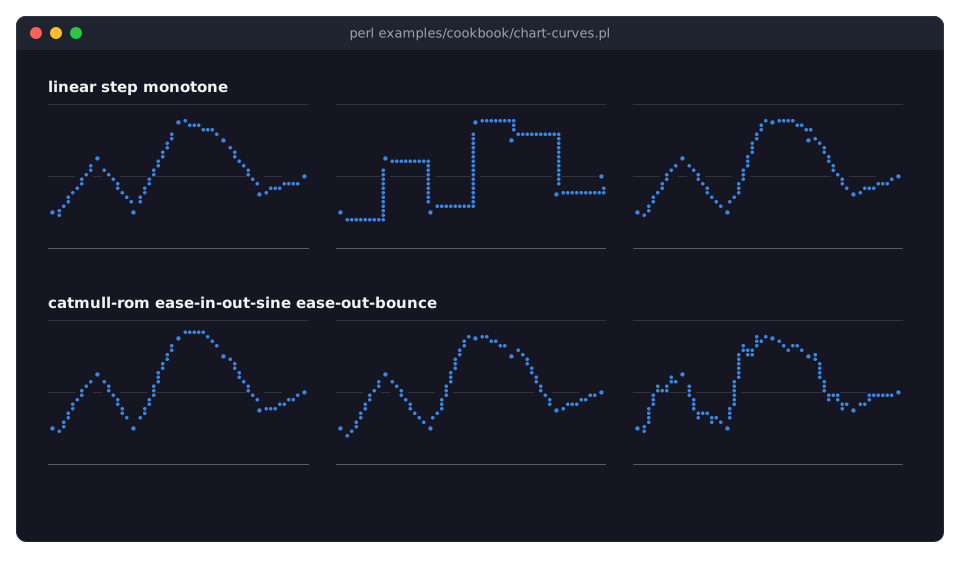
The last two charts in the picture use easings; the program is in "Connect points with curves and easings (curve)" in Term::Fabulous::Cookbook::ChartStyles.
FUNCTIONS
easing
my $function = easing($name);The function of a name: a code reference from t (0 to 1) to the eased t (0 at 0, 1 at 1). Dies for an unknown name, with all names in the message.
easing_names
All names, linear included, sorted.
is_easing_name
1 for an easing name, else 0.
SEE ALSO
Term::Fabulous::Chart::Curve, "Curves" in Term::Fabulous::Widget::XYChart.