Beekeeper
Beekeeper is a framework for building applications with a microservices architecture.

A pool of worker processes handle requests and communicate with each other through a common message bus.
Clients send requests through a different set of message buses, which are isolated for security reasons.
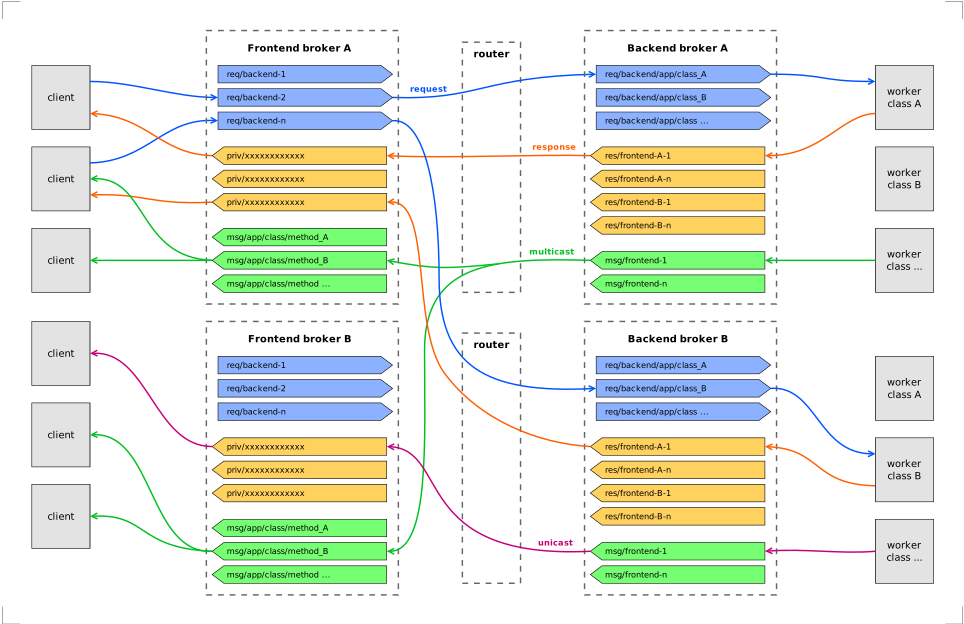
Requests and responses are shoveled between buses by a few router processes.
Benefits of this architecture:
-
Scales horizontally very well. It is easy to add or remove workers, routers or brokers.
-
High availability. The system remains responsive even when several components fail.
-
Easy integration of browsers via WebSockets or clients written in other languages.
Key characteristics:
-
Broker is a messaging server like Apache ActiveMQ or RabbitMQ.
-
Broker protocol is STOMP (see the specification).
-
RPC protocol is JSON-RPC 2.0 (see the specification).
-
Message marshalling is JSON.
-
No message persistence in the broker, it just passes on messages.
-
No routing logic is defined in the broker.
-
Blends synchronous and asynchronous workers or clients.
-
Efficient multicast and unicast notifications.
-
Inherent load balancing.
What does this framework provides:
-
Beekeeper::Worker, a base class for writing service workers. -
Beekeeper::Client, a class for writing service clients. -
bkprcommand which spawns and controls worker processes. -
Command line tools for monitoring and controlling remotely worker pools.
-
A simple internal broker handy for development or running tests.
-
Automatic message routing between frontend and backend buses.
-
Centralized logging, which can be shoveled to an external monitoring application.
-
Performance metrics gathering, which can be shoveled to an external monitoring application.
Getting Started
Writing workers
Workers provide a service accepting certain RPC calls from clients. The base class Beekeeper::Worker provides all the glue needed to accept requests and communicate trough the message bus with clients or another workers.
A worker class just declares on startup which methods it will accept, then implements them:
package MyApp::Worker;

use base 'Beekeeper::Worker';

sub on_startup {
    my $self = shift;

    $self->accept_jobs(
        'myapp.str.uc' => 'uppercase',
    );
}

sub uppercase {
    my ($self, $params) = @_;

    return uc $params->{'string'};
}
Writing clients
Clients of the service need an interface to use it without knowledge of the underlying RPC mechanisms. The class Beekeeper::Client provides simple methods to connect to the broker and make RPC calls.
This is the interface of the above service:
package MyApp::Client;

use Beekeeper::Client;

sub uppercase {
    my ($class, $str) = @_;

    my $client = Beekeeper::Client->instance;

    my $resp = $client->do_job(
        method => 'myapp.str.uc',
        params => { string => $str },
    );

    return $resp->result;
}
Then other workers or clients can just:
use MyApp::Client;

print MyApp::Client->uppercase("hello!");
Configuring
Beekeeper applications use two config files to define how clients, workers and brokers connect to each other. These files are searched for in ENV BEEKEEPER_CONFIG_DIR, ~/.config/beekeeper and then /etc/beekeeper. File format is relaxed JSON, which allows comments and trailings commas.
The file pool.config.json defines all worker pools running on a host, specifying which logical bus should be used and which services it will run. For example:
[{
    "pool-id" : "myapp",
    "bus-id"  : "backend",
    "workers" : {
        "MyApp::Worker" : { "workers_count" : 4 },
    },
}]
The file bus.config.json defines all logical buses used by the application, specifying the connection parameters to the brokers that will service them. For example:
[{
    "bus-id"  : "backend",
    "host"    : "localhost",
    "user"    : "backend",
    "pass"    : "def456",
    "vhost"   : "/back",
}]
Neither the worker code nor the client code have hardcoded references to the logical message bus or the broker connection parameters, they communicate to each other using the definitions in these two files.
Running
To start or stop a pool of workers you use the bkpr command. Given the above example config, this will start 4 processes running MyApp::Worker code:
bkpr --pool-id "myapp" start
When started it daemonizes itself and forks all worker processes, then continues monitoring those forked processes and immediately respawns defunct ones.
The framework includes these command line tools to manage worker pools:
-
bkpr-topallows to monitor in real time the performance of all workers. -
bkpr-logallows to monitor in real time the log output of all workers. -
bkpr-restartgracefully restarts local or remote worker pools.
Performance
Beekeeper is pretty lightweight, so the performance depends mostly on the broker performance. These are ballpark performance measurements of a local setup running ActiveMQ:
-
A
do_jobsynchronous call to a remote method adds 1.5 ms of latency and involves 4 network round trips. This implies a maximum of 650 synchronous calls per second. -
A
do_async_jobasynchronous call to a remote method takes 0.1 ms. This implies a maximum of 10000 asynchronous calls per second (just the call, then it must wait for responses). -
Scheduling a remote task with
do_background_jobtakes 0.1 ms. This implies a maximum of 10000 calls per second. -
Sending a notification with
send_notificationtakes 0.1 ms. A worker can emit 10000 notifications per second, even over 15000 if these are smaller than 1 KB. -
A worker processing remote calls adds 0.3 ms of latency and involves 2 network round trips. So a single worker can handle a maximum of 3300 requests per second.
-
A worker adds an overhead of 0,04% CPU load per request.
-
A worker uses 10 MB of resident memory.
-
Frontend router adds 5 ms of latency and involves 2 additional network round trips.
Hypothetical example:
Suppose it is needed to handle 1000 requests per second to a task that takes 25 ms to complete, uses 20 MB of memory and has 10% CPU load. Servers are in the same datacenter and the network roundtrip is 0.1 ms.
Adding framework and network latency, a single worker can handle:
1000 ms / (25 ms + 0.3 ms + 0.1 ms * 2) = 39 req/s
In order to handle 1000 requests per second:
1000 req/s / 39 req/s = 26 workers
The memory needed is:
26 workers * (20 MB + 10 MB) = 780 MB
The CPU needed is:
26 * 10% + 1000 * 0,04% = 300% = 3 cores
End user latency is:
25 ms + 0.3 ms + 5 ms + 0.1 ms * 6 = 31 ms + user latency
Backend broker receives 2000 msg/s and sends 2000 msg/s, giving a 4000 msg/s total traffic. Frontend broker receives 1000 msg/s and sends 1000 msg/s, giving a 2000 msg/s total traffic.
These numbers will improve a bit when running on beefier CPUs, and worsen a lot if broker performance degrades under heavy load.
Examples
This distribution includes some examples that can be run out of the box using an internal ToyBroker (so no install of a proper broker is needed):
examples/basic is a barebones example of the usage of Beekeper.
examples/flood allows to estimate the performance of a Beekeper setup.
examples/webstomp use a service from a browser using WebSockets.
examples/chat implements a real world setup with isolated buses and redundancy.
See also
-
Notes on supported brokers configuration.
-
Beekeeper message routing diagram.
TODO
Since this project was started (and even then) STOMP has been completely surpassed as a fast and simple messaging protocol by superior MQTT. And since 2019, when MQTT version 5.0 was released, many brokers started to implement the routing features needed by Beekeeper to run.
So the underlying broker protocol should be changed to MQTT, in order to take advantage of better supported modern brokers.
Dependencies
This framework requires Anyevent, JSON::XS, Term::ReadKey, Test::Class, and ps.
To install these dependencies on a Debian system do:
apt install libanyevent-perl
apt install libjson-xs-perl
apt install libterm-readkey-perl
apt install libtest-class-perl
apt install procps
License
Copyright 2015 José Micó.
This is free software; you can redistribute it and/or modify it under the same terms as the Perl 5 programming language itself.