

NAME
week - colorful calendar command for ANSI terminal
SYNOPSIS
week [ -M_module_ ] [ option ] [ date ]
Options:
-#,-m#  # months surrounding today (default 3)
-A #    after current month
-B #    before current month
-C[#]   before and after current month (default 4)
-y      year calendar
-Y[#]   # years of calendar
-c #    number of columns (default 3)
-p #    print year on month-# (default current, 0 for none)
-P      print year on all months
-W      print week number

--theme theme
        apply color theme
Color options:
--colormap  specify colormap
--rgb24     use 24bit RGB color ANSI sequence
i18n options:
-l          list i18n options
--i18n      enable i18n options
--i18n-v    display with Territory/Language information
Color modules:
-Mcolors
-Mnpb
-Molympic
VERSION
Version 1.07
DESCRIPTION
By default, the week command displays the previous, current and next month surrounding today, just like the -3 option of the cal(1) command.
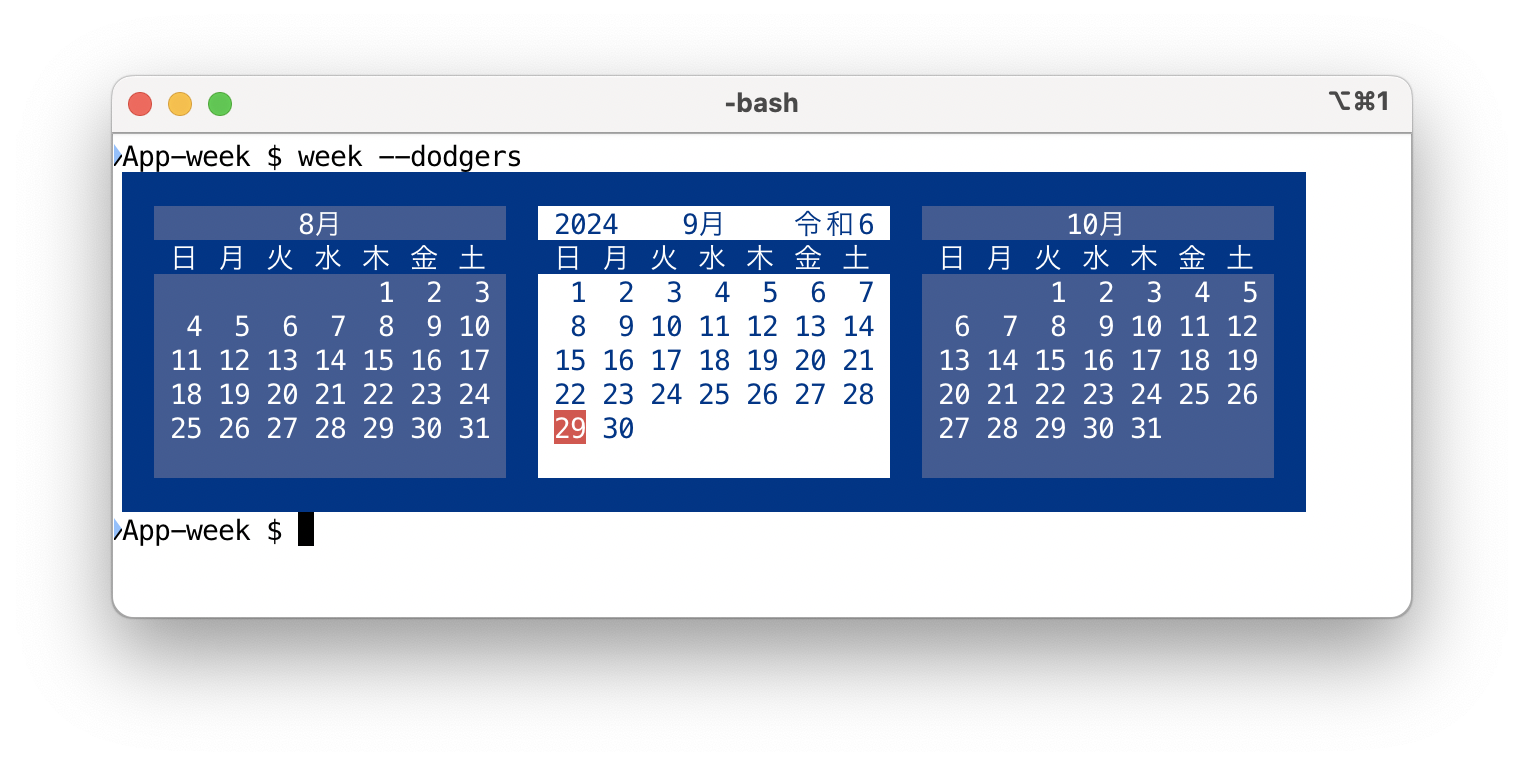
The number of months can be given with a dash or the -m option, which can be combined with other parameters. -c option specifies number of columns.
$ week -12
$ week -m21c7
The number of months before and after can be specified with the -B and -A options, and -C for both.
$ week -B4 -A4
$ week -C4
A date can be given like:
$ week 2019/9/23
$ week 9/23        # 9/23 of current year
$ week 23          # 23rd of current month
And also in Japanese format and era:
$ week 2019年9月23日
$ week 平成31年9月23日
$ week H31.9.23
$ week 平成31
$ week 平31
$ week H31
A larger number is treated as a year. The next command displays the calendar for the year 1752.
$ week 1752
Use the -y option to show a one-year calendar. The number of years can be specified by the -Y option (must be 100 or less), which implicitly sets the -y option.
$ week -y          # display this year's calendar

$ week -Y2c6       # display 2 years calendar in 6 column
INTERNATIONAL SUPPORT
It is possible to display the calendar in various languages by setting locale environment variables.
LANG=et_EE week
LC_TIME=et_EE week
This command comes with the -Mi18n module, which provides an easy
way to specify a language by command option. Option -l displays
the option list provided by the -Mi18n module, and options
--i18n and --i18n-v enable them. When using --i18n options, the LC_TIME environment
variable is set to control date and time formatting specifically.
See Getopt::EX::i18n.
$ week --i18n-v --et
JAPANESE ERA
By default, the chronological year is shown on the current month and every January. When used in a Japanese locale environment, the year on the right side is displayed in Japanese era (wareki: 和暦) format.
WEEK NUMBER
Using the -W or --weeknumber option, the week number is printed at the end of every week line. Week number 1 is the week that includes January 1st, and it counts up every Sunday.

Option -W2 prints the standard week number, which starts with the first Sunday of the year.

Option -W3 prints the ISO 8601 style week number. Because ISO weeks start on Monday, and the command shows the number for the Sunday of the week, the result is not intuitive and therefore, I guess, useless.

Option -W2 and -W3 require gcal(1) command installed.
COLORMAP
Each field is labeled by names.
FRAME       Enclosing frame
MONTH       Month name
WEEK        Day of the week
DAYS        Calendar
THISMONTH   Target month name
THISWEEK    Target day of the week
THISDAYS    Target calendar
THISDAY     Target date
Color for each field can be specified by --colormap (--cm) option with LABEL=colorspec syntax. Default color is:
--colormap      DAYS=L05/335 \
--colormap      WEEK=L05/445 \
--colormap     FRAME=L05/445 \
--colormap     MONTH=L05/335 \
--colormap   THISDAY=522/113 \
--colormap  THISDAYS=555/113 \
--colormap  THISWEEK=L05/445 \
--colormap THISMONTH=555/113
Besides above, color for day-of-week names (and week number) can be specified individually by following labels. No color is assigned to these labels by default.
DOW_SU  Sunday
DOW_MO  Monday
DOW_TU  Tuesday
DOW_WE  Wednesday
DOW_TH  Thursday
DOW_FR  Friday
DOW_SA  Saturday
DOW_CW  Week Number
Three digit means 216 RGB values from 000 to 555, and L01
.. L24 mean 24 gray scale levels. Colormap is handled by
Getopt::EX::Colormap module; use `perldoc Getopt::EX::Colormap` for
detail.
You can add a special effect afterward. For example, put next line in
your ~/.weekrc to blink today. $<move> indicates to move
all following arguments here, so that insert this option at the end.
option default $<move> --cm 'THISDAY=+F'
I18N
-
--i18n
-
--i18n-v
Both of these enable I18N options, and Territory/Language information is shown when --i18n-v is used. These options set the
LC_TIMEenvironment variable to control date and time formatting specifically, rather than the generalLANGvariable.
MODULES
Some modules are included in the distribution. These options can be used without any special action, because they are defined to load the appropriate module automatically in the default startup module (App::week::default).
-
-Mcolors
--mono --lavender --green --pastel -
-Mmlb (Major League Baseball)
--dodgers, --dodgers-rev --yankees, --yankees-rev -
-Mnpb (Nippon Professional Baseball Organization)
--tigers, --tigers-rev --giants, --giants-rev --lions, --lions-rev -
-Molympic
--tokyo2020, --tokyo2020-rev --tokyo2020-gold, --tokyo2020-gold-rev --para2020, --para2020-rev -
--theme
Option --theme is defined in the default module and chooses the appropriate variant of the given theme according to the background color of the terminal. If you have the following setting in your
~/.weekrc:option --theme tokyo2020Option --tokyo2020 is set for a light terminal, and --tokyo2020-rev is set for a dark terminal.
Feel free to update these modules and send pull request to github site.
FILES
-
~/.weekrcStart up file. Use like this:
option default --i18n-v --theme tokyo2020
INSTALL
CPANMINUS
$ cpanm App::week
SEE ALSO
App::week, https://github.com/kaz-utashiro/App-week
Getopt::EX::termcolor, https://github.com/kaz-utashiro/Getopt-EX-termcolor
Getopt::EX::i18n, https://github.com/kaz-utashiro/Getopt-EX-i18n
https://qiita.com/kaz-utashiro/items/603f4bca39e397afc91c
https://qiita.com/kaz-utashiro/items/38cb50a4d0cd34b6cce6
https://qiita.com/kaz-utashiro/items/be37a4d703f9d2208ed1
AUTHOR
Kazumasa Utashiro
LICENSE
You can redistribute it and/or modify it under the same terms as Perl itself.
COPYRIGHT
The following copyright notice applies to all the files provided in this distribution, including binary files, unless explicitly noted otherwise.
Copyright ©︎ 2018-2026 Kazumasa Utashiro