NAME
Term::Fabulous::Widget::Text - A piece of text inside a box
SYNOPSIS
use utf8;    # this source file contains non-ASCII text
use Term::Fabulous::Widget::Text;

my $title = Term::Fabulous::Widget::Text->new(
	text       => 'Settings',
	text_color => [ 255, 255, 255, 255 ],
);

# Text is a character string, like everywhere in Term::Fabulous:
my $greeting = Term::Fabulous::Widget::Text->new(
	id         => 'greeting',
	text       => 'Grüße',
	text_color => [ 230, 230, 230, 255 ],
);

# Later, change what it shows:
$greeting->text('Hello again');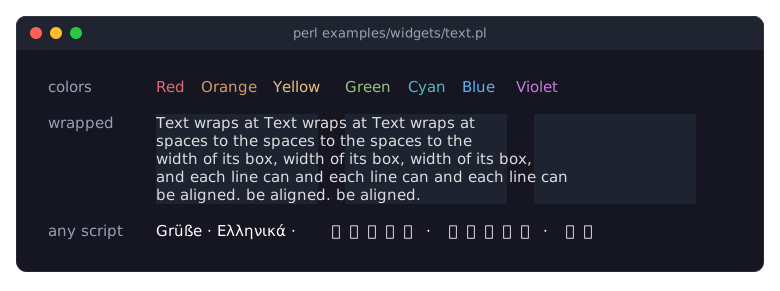
The program is examples/widgets/text.pl.
DESCRIPTION
A Text widget shows text inside its parent widget, usually a Term::Fabulous::Widget::Box. The layout makes it as wide as its longest line, wraps it at spaces when the parent is too narrow, and starts a new line at every "\n". Text has a color but no background of its own: every cell shows the background that was painted below it.
A Text widget is a leaf: it cannot have children, and it has no border, padding or background. To give text a background, a border or a fixed size, put it in a Box. Mouse events (Mouse, MouseMove) go to the box behind a text, and a Text never has the keyboard focus (a Term::Fabulous::Widget::RichText with links does). A mouse button pressed on a character of the text also fires TextClick on the Text, with the character and the word under the pointer, so that the widgets around it can react to the words that were clicked (see "click_at").
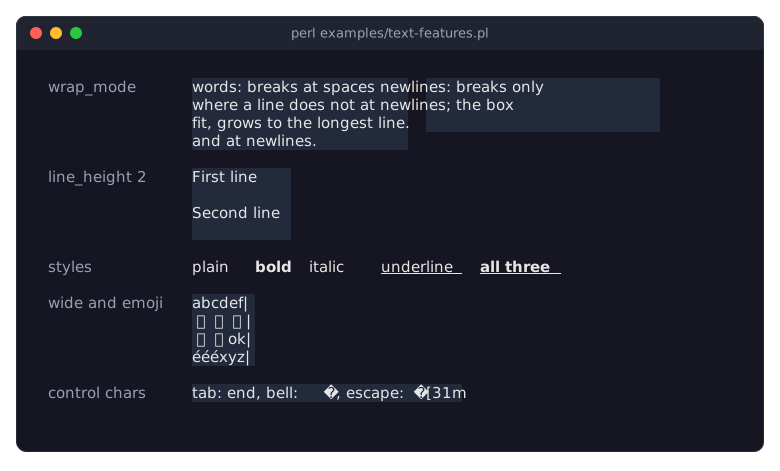
examples/text-features.pl shows the wrap modes, line height, bold, italic and underlined text, wide characters and control characters:
The text section of the looks guide explains all of this with examples. The class is built on Clay::UI::Text.
CONSTRUCTOR
new
my $text = Term::Fabulous::Widget::Text->new(%parameters);All parameters are optional; unknown parameters die. Every parameter except id also has an accessor of the same name.
text-
A character string, like all text in Term::Fabulous. Default:
''.Bytes read from a file, a command or a socket must be decoded first with
Encode::decode('UTF-8', $bytes); otherwise each byte is shown as one Latin-1 character. Text read from a KDL layout is used as is. See "Text is character strings" in Term::Fabulous::Manual::Looks.Control characters are never sent to the terminal: a TAB is shown as one space and every other control character, a carriage return included, as U+FFFD (see "Control characters" in Term::Fabulous::Manual::Looks). Wide characters (most CJK characters and emoji) take two cells (see "Wide characters and emoji" in Term::Fabulous::Manual::Looks).
undefand references die. text_color-
The color of the characters, in any format Term::Fabulous::Color accepts:
[r, g, b, a](or[r, g, b]),{ r, g, b, a }, a string such as'#ffffff'or'rgb(255, 255, 255)', a packed0xRRGGBBinteger, or a Term::Fabulous::Color object such as an item of Term::Fabulous::Enum::WebColor; it is stored as[r, g, b, a]. An alpha from 1 to 254 is drawn opaque. Default: the theme'stext.color([220, 223, 228, 255]in the dark theme), or, inside a widget that colors its texts (a Term::Fabulous::Widget::Button), that widget's text look. Pass[0, 0, 0, 0](alpha 0) for the terminal's default foreground color. See "COLORS" in Term::Fabulous::Manual::Looks and "THEMES" in Term::Fabulous::Manual::Looks. classes-
An array reference of strings. Default:
[]. Names that select the theme's variants of thetextfamily, as for "classes" in Term::Fabulous::Widget.Inside a disabled Term::Fabulous::Widget::Button, the text is drawn in the button's
disabled_colorinstead, whatever itstext_color. bolditalicunderline-
Booleans, default 0: draw the characters bold, italic or underlined. Any true or false value; references die. Terminals show these styles with the font they have, so a font without an italic face may show italic text upright. They take no space and do not change the layout. These three are the only text styles, and they apply to the whole text; a Term::Fabulous::Widget::RichText styles ranges of it. See "Bold, italic and underline" in Term::Fabulous::Manual::Looks.
id-
A string naming the widget, for your own use (for example to find a Text in a tree built from a layout). Default: none. Unlike a Box's id, it is not passed to Clay and does not need to be unique, and "remove_child_with_id" in Term::Fabulous::Widget does not remove Text widgets by id ("remove_child" in Term::Fabulous::Widget removes the widget itself). Read it with
$text->id; there is no writer.find_by_idfinds Text widgets by this id. wrap_mode-
How lines are broken, one of the Clay::XS constants:
CLAY_TEXT_WRAP_WORDS(the default: break at"\n"and, where the text does not fit, at spaces),CLAY_TEXT_WRAP_NEWLINES(break only at"\n") andCLAY_TEXT_WRAP_NONE(the same asCLAY_TEXT_WRAP_NEWLINES, because Clay lays out both alike). A line that is not broken may be wider than the parent; it is cut off at the right edge of the terminal.With every mode, only spaces are break points: a single word that is wider than the space available, or text without spaces such as a Japanese sentence, is never broken: it runs past the right edge of its parent and is cut off only at the edge of the terminal or of an enclosing Term::Fabulous::Widget::ScrollBox. See "Wrapping" in Term::Fabulous::Manual::Looks.
text_alignment-
CLAY_TEXT_ALIGN_LEFT(the default),CLAY_TEXT_ALIGN_CENTERorCLAY_TEXT_ALIGN_RIGHT. Aligns the lines of a multi-line text against each other, within the width of its longest line. It has no visible effect on a single line: to center a Text in its box, setchild_alignmentin the box'slayout(see "new" in Term::Fabulous::Widget). line_height-
The number of rows each line takes, an integer from 0 to 65535; other values (such as
1.5) die. Default: 0, which means one row, like 1. A line is drawn in the middle row of its rows (the upper middle row when the number is even), so with2an empty row follows every line. See "Line height" in Term::Fabulous::Manual::Looks. font_idfont_sizeletter_spacing-
Accepted because Clay::UI supports them, but without effect in a terminal: every character is drawn in the terminal's font, one character per cell. Each is an integer from 0 to 65535; other values die. Defaults:
font_id0,font_size16,letter_spacing0.
METHODS
Besides the accessors below, a Text widget has the methods parent, root, ui and on that every widget has (see Term::Fabulous::Widget); on is rarely useful, because no events are fired on Text widgets.
text
my $text = $label->text;
$label->text($new_text);
Accessor. Without an argument it returns the current value; with an argument it sets it and returns the new value. An invalid value dies like the constructor parameter. The change shows in the next frame. The text is a character string; the layout adapts to the new length.
text_color
my $rgba = $label->text_color;
$label->text_color( [ 255, 80, 80, 255 ] );
$label->text_color('#ff5050');
Accessor. Without an argument it returns the color in use, the given one or the theme's, as [r, g, b, a]; with an argument it sets it, in any format the constructor parameter accepts, and returns the stored [r, g, b, a]. An invalid value dies like the constructor parameter, and so does undef: $label->reset_look('text_color') returns the text to the theme. The change shows in the next frame.
classes
$label->classes( ['muted'] );Accessor for the classes parameter, as "classes" in Term::Fabulous::Widget.
reset_look
$label->reset_look('text_color');Drops the given text_color, so the theme's text color is drawn again; see "reset_look" in Term::Fabulous::Widget.
bold
$label->bold(1);italic
$label->italic(1);underline
$label->underline(1);Accessors for the constructor parameters of the same names (0 or 1). Without an argument they return the current value; with an argument they set it and return the new value. The change shows in the next frame.
style_attrs
my $bits = $label->style_attrs;The termbox2 style bits (TB_BOLD, TB_ITALIC, TB_UNDERLINE, see Term::Fabulous::Termbox) of the current bold, italic and underline values, combined; 0 for plain text. The renderer adds them to the text color.
id
my $id = $label->id;The id given to the constructor, or undef. There is no writer.
wrap_mode
$label->wrap_mode(CLAY_TEXT_WRAP_NONE);Accessor. Without an argument it returns the current value; with an argument it sets it and returns the new value. An invalid value dies like the constructor parameter. The change shows in the next frame. The reader returns undef when it was never set, which behaves as CLAY_TEXT_WRAP_WORDS.
text_alignment
$label->text_alignment(CLAY_TEXT_ALIGN_RIGHT);Accessor. Without an argument it returns the current value; with an argument it sets it and returns the new value. An invalid value dies like the constructor parameter. The change shows in the next frame. The reader returns undef when it was never set, which behaves as CLAY_TEXT_ALIGN_LEFT.
line_height
$label->line_height(2);Accessor. Without an argument it returns the current value; with an argument it sets it and returns the new value. An invalid value dies like the constructor parameter. The change shows in the next frame.
font_id
$label->font_id(1);Accessor. Without an argument it returns the current value; with an argument it sets it and returns the new value. An invalid value dies like the constructor parameter. It has no effect in a terminal.
font_size
$label->font_size(16);Accessor. Without an argument it returns the current value; with an argument it sets it and returns the new value. An invalid value dies like the constructor parameter. It has no effect in a terminal; the default is 16.
letter_spacing
$label->letter_spacing(0);Accessor. Without an argument it returns the current value; with an argument it sets it and returns the new value. An invalid value dies like the constructor parameter. It has no effect in a terminal.
tree_changed
Clay::UI calls it on every widget of a subtree whose place in a tree changed (see "tree_changed" in Clay::UI::Role::Layout::HasParent). A Text forgets the looks it fetched here, as "tree_changed" in Term::Fabulous::Widget does.
click_at
use Term::Fabulous::Termbox qw(TB_KEY_MOUSE_LEFT);

$text->click_at( $offset, TB_KEY_MOUSE_LEFT, $x, $y );
Fires TextClick on the widget for a press of the mouse button (TB_KEY_MOUSE_LEFT, TB_KEY_MOUSE_MIDDLE or TB_KEY_MOUSE_RIGHT) on the character at $offset of the text, with the pointer at the cell $x, $y. The event carries the word the character belongs to (the run of non-blank characters around it). Term::Fabulous calls it after the Mouse event of every button press on a character of the text; call it yourself to click a text in a test. An offset that is not a character of the text dies. Returns the widget.
EVENTS
A Text fires TextClick (Term::Fabulous::Event::TextClick) when a mouse button is pressed on one of its characters; it bubbles to the widgets around the text. The recipe "React to a click on a word (TextClick)" in Term::Fabulous::Cookbook::KeyboardAndMouse looks up the clicked word. A Text can fire events of your own with fire_event (Clay::UI::Role::Events::Emitter), and on adds listeners to it.
KDL PROPERTIES
Text "greeting" {
	text "Gr\u{fc}\u{df}e, world"
	text_color "#e6e6e6"
	bold #true
	line_height 2
	wrap_mode newlines
	text_alignment center
}
The node's argument ("greeting") is the id. Inside the block:
text "..."-
Exactly one string. It is used as is, so write any characters directly (KDL files are UTF-8).
text_color "..."-
Exactly one argument: any color string Term::Fabulous::Color understands, such as
"#ffffff","rgb(255, 255, 255)"or"hsl(0, 0%, 100%)". bold #trueitalic #trueunderline #true-
Exactly one boolean each:
#true,#false,1or0. wrap_mode words-
Exactly one name:
words(CLAY_TEXT_WRAP_WORDS),newlines(CLAY_TEXT_WRAP_NEWLINES) ornone(CLAY_TEXT_WRAP_NONE). See thewrap_modeparameter of "new". text_alignment left-
Exactly one name:
left(CLAY_TEXT_ALIGN_LEFT),center(CLAY_TEXT_ALIGN_CENTER) orright(CLAY_TEXT_ALIGN_RIGHT). See thetext_alignmentparameter of "new". line_height Nfont_id Nfont_size Nletter_spacing N-
One integer each; see "new".
font_id,font_sizeandletter_spacinghave no effect in a terminal.
An unknown wrap_mode or text_alignment name dies with the known names. Any other property dies. A Text node cannot have child widgets.
SUBCLASS INTERFACE
These methods are used by Term::Fabulous::Layout; you do not call them yourself.
layout_properties
my %kind_of = Term::Fabulous::Widget::Text->layout_properties;The table of the properties a layout may set (see "layout_properties" in Term::Fabulous::Role::CanParseLayout): font_id, font_size, letter_spacing and line_height are scalars, text_color is a color, bold, italic and underline are booleans, and text, wrap_mode and text_alignment are structured properties the Text parses itself; see "KDL PROPERTIES".
SEE ALSO
"TEXT" in Term::Fabulous::Manual::Looks, Term::Fabulous::Widget::Box, Term::Fabulous::Widget::RichText, Term::Fabulous::Unicode, Clay::UI::Text, "Wrap, align and space text" in Term::Fabulous::Cookbook::GettingStarted, "Show non-ASCII text (umlauts, CJK, combining accents)" in Term::Fabulous::Cookbook::GettingStarted.